

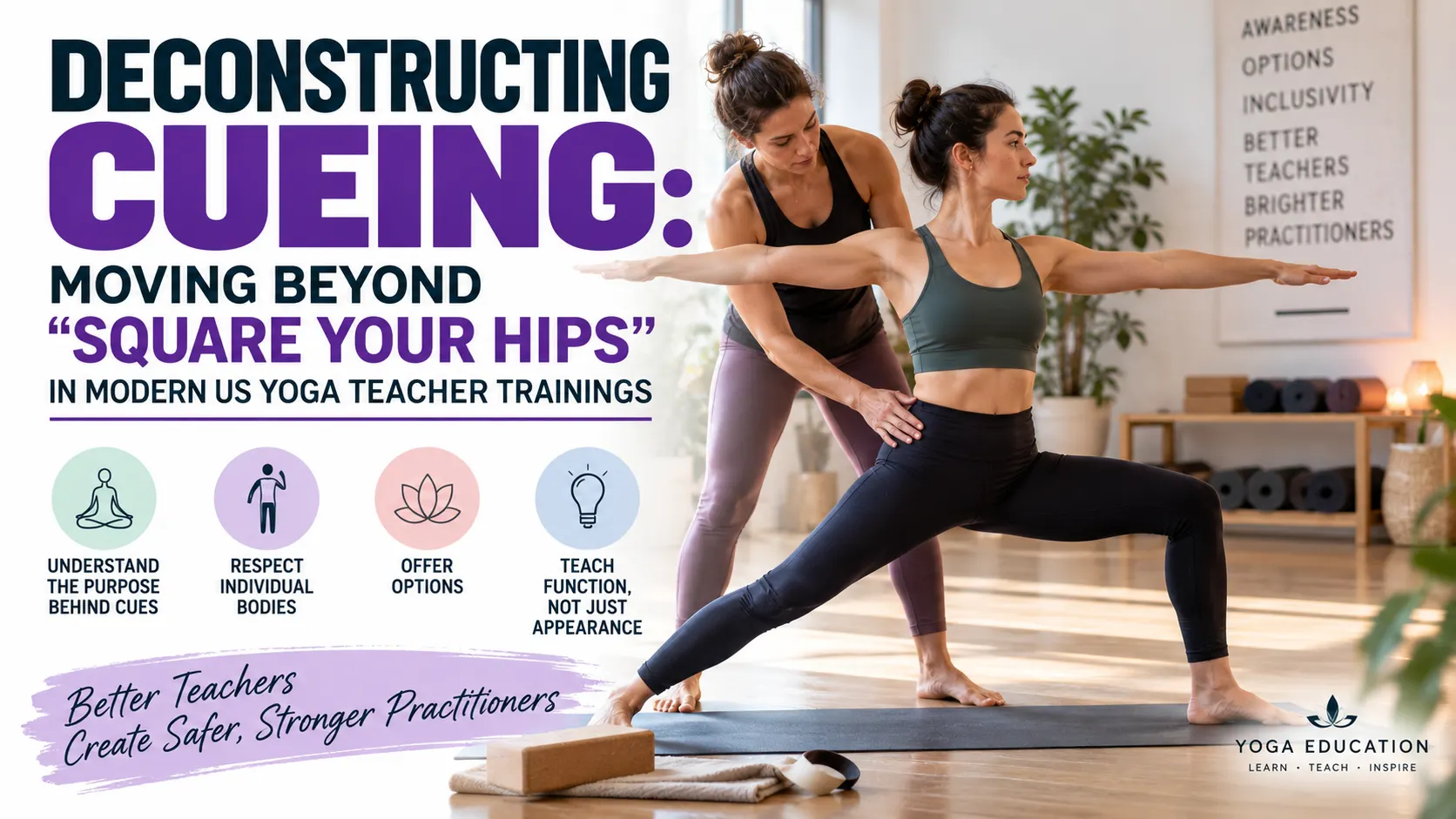
Yoga teacher training often gives students a collection of familiar instructions: “square your hips,” “draw your shoulders down,” “keep your spine straight,” or “point your toes forward.”
These cues can be useful starting points, but modern yoga teaching increasingly asks a deeper question:
Does the cue actually help every student move safely and effectively?
The answer is not always simple.
Bodies are different. Hip structures, bone shapes, joint mobility, muscular strength, previous injuries, movement habits, and individual goals can all affect how a yoga pose looks and feels.
This is why yoga teacher training should teach more than memorized instructions. Future teachers need to understand the purpose behind a cue, recognize individual differences, and learn how to offer options rather than forcing every student into the same shape.
One example that deserves a closer look is the familiar instruction:
“Square your hips.”
In some situations, this cue may help students understand the intended direction of a pose. In others, trying too hard to make the hips perfectly square can create unnecessary tension or discomfort.
This article explores how yoga teachers can move beyond rigid alignment language and develop more thoughtful, functional, and student-centered cueing.
What Does “Square Your Hips” Actually Mean?
The instruction “square your hips” is commonly used in poses where the legs are positioned in different directions, such as Warrior I, High Lunge, or certain standing sequences.
Usually, the teacher is trying to communicate something about the orientation of the pelvis.
The intention may be to encourage the student to:
- Face the pelvis toward the front of the mat
- Avoid excessive rotation
- Create a stable foundation
- Organize the lower body
- Maintain awareness of pelvic movement
The problem is that “square your hips” can sound much more precise than it actually is.
The pelvis is not a rectangular object that can simply be turned until its edges are perfectly parallel with the front of a yoga mat.
Human movement is more complex.
Why One Alignment Cue Does Not Work for Every Body
Every person’s skeletal structure is different.
The shape and orientation of the hip socket, the angle of the femur, the mobility of the pelvis, and the flexibility of surrounding muscles can influence how someone naturally moves.
Two students can perform the same pose with different-looking hip positions while both are moving comfortably and effectively.
This is an important lesson for anyone considering 200-hour yoga teacher training.
Teacher training should help students understand that alignment is not always about making every body look identical.
From Appearance-Based Cueing to Functional Cueing
Traditional yoga instruction can sometimes focus heavily on what a pose should look like.
For example:
“Square your hips.”
“Keep your hips level.”
“Make your feet parallel.”
These instructions focus primarily on external appearance.
Functional cueing asks a different question:
What is the student trying to achieve?
Instead of simply telling a student where to put a body part, a teacher can explain the purpose behind the movement.
For example:
Instead of:
“Square your hips.”
A teacher might say:
“Orient your pelvis toward the front of the mat as much as feels comfortable, while keeping your front knee tracking in a comfortable direction.”
This gives the student a goal without demanding an identical shape.
Why Context Matters
A cue that is useful in one pose may not be appropriate in another.
The same student may need different instructions depending on:
- The pose
- Their range of motion
- Their experience
- Their balance
- Their strength
- Their physical limitations
- Their reason for practicing
This is why good cueing requires observation.
A teacher should not rely entirely on a predetermined script.
Understanding the Difference Between Position and Function
One of the most useful concepts for modern yoga teachers is the difference between position and function.
Position describes where a body part appears to be.
Function describes what the body is doing.
For example:
“Keep your hips square” describes a position.
“Create a stable base while allowing comfortable movement through the hips” describes a function.
The second approach gives the student more freedom while still communicating the purpose of the movement.
The Problem With Absolute Language
Words such as:
- Always
- Never
- Must
- Perfectly
- Correct
- Wrong
can create unnecessary pressure when teaching movement.
Human bodies do not always fit absolute rules.
For example:
“Your hips must be perfectly square.”
This can encourage students to force their pelvis into a position that may not feel natural.
A more adaptable instruction might be:
“Explore how much you can rotate the pelvis forward without creating strain.”
The second cue encourages awareness rather than compliance.
Cueing Should Have a Purpose
Before giving a cue, teachers can ask themselves:
Why am I saying this?
If the answer is unclear, the cue may not be necessary.
A useful cue might help a student:
- Improve balance
- Understand a movement
- Reduce unnecessary tension
- Increase body awareness
- Find a comfortable position
- Explore a movement safely
- Connect breathing with movement
The objective should be more important than making the student’s pose look identical to the teacher’s.
Teaching Alignment Without Creating Fear
Alignment education is valuable, but teachers should be careful not to create fear around normal movement.
Students sometimes hear statements suggesting that one small deviation will automatically cause injury.
Human movement is more complicated than that.
A single position does not determine whether a movement is safe or unsafe for every person.
Instead, teachers can encourage students to notice:
- Pain
- Pressure
- Unusual discomfort
- Instability
- Excessive strain
- Difficulty controlling the movement
This creates a more useful relationship between alignment and body awareness.
How Beginners Can Learn Better Cueing
For someone beginning yoga teacher education, cueing can feel overwhelming.
There are many things to remember:
- Pose names
- Breathing
- Alignment
- Transitions
- Timing
- Demonstration
- Safety
- Student observation
A structured yoga teacher training program can provide an environment where students can practice these skills gradually.
The goal should not be to memorize hundreds of instructions.
Instead, learn to understand the movement.
Use External and Internal Cues
Teachers can use different types of instructions.
External Cues
External cues focus on an object, direction, or relationship with the environment.
Examples:
- “Press the floor away.”
- “Reach toward the front of the room.”
- “Lengthen through the crown of your head.”
Internal Cues
Internal cues focus on sensations or body awareness.
Examples:
- “Notice the sensation around your hips.”
- “Feel your breath moving through your ribs.”
- “Notice whether your shoulders are gripping.”
Both approaches can be useful.
The best choice depends on the student and the learning objective.
Demonstration Is Not Always the Same as Instruction
Teachers often demonstrate a pose while explaining it.
However, students may assume that the teacher’s exact shape is the only correct version.
This can be problematic.
A teacher can demonstrate one variation while explaining that students may use different positions based on their own bodies.
For example:
“Here’s one way to approach the pose. Your stance may look different, and that’s okay as long as you can move comfortably and maintain control.”
This small change in language can reduce unnecessary comparison.
The Role of Anatomy in Modern Cueing
Anatomy education can help teachers understand why students move differently.
The hip joint is particularly important because its structure varies between individuals.
Factors such as:
- Bone shape
- Joint orientation
- Femur angle
- Muscle length
- Previous injury
- Mobility
- Strength
can influence movement.
This does not mean yoga teachers need to become medical professionals.
It means teachers should understand enough basic anatomy to avoid treating every body as though it has identical mechanical characteristics.
Avoid Turning Anatomy Into Diagnosis
There is another important boundary.
Yoga teachers can observe movement and provide appropriate options, but they should not diagnose injuries or medical conditions unless they have separate professional qualifications allowing them to do so.
For example, a teacher can say:
“Try a shorter stance and see whether that feels more comfortable.”
A teacher should be cautious about saying:
“Your hip is misaligned because you have a specific structural problem.”
Good teaching recognizes the limits of the teacher’s role.
Cueing for Different Experience Levels
A beginner may need simple instructions.
An experienced practitioner may benefit from more detailed exploration.
For example, a beginner may need:
“Step your right foot forward and bend your front knee.”
An experienced student may benefit from:
“Explore the relationship between your pelvis and rib cage while maintaining steady breathing.”
The same class can contain different levels of cueing.
How to Make Cueing More Student-Centered
A student-centered teacher does not simply give instructions.
They observe.
They listen.
They adapt.
They ask questions.
Useful questions include:
- “How does that feel?”
- “Would a shorter stance feel better?”
- “Does this variation give you more stability?”
- “Can you breathe comfortably here?”
- “Would you like to try another option?”
These questions turn the class into an exploration rather than a test.
The Importance of Offering Options
Instead of presenting one version of a pose as the correct version, teachers can offer variations.
For example:
Option 1: Traditional stance
Option 2: Shorter stance
Option 3: Use a wall or chair for support
Option 4: Reduce the depth of the pose
Options allow students to participate without feeling that their body is failing to achieve the “correct” shape.
Cueing in a 200-Hour Training Environment
Cueing is one of the skills that future teachers need to practice repeatedly.
Students can learn by:
- Watching experienced teachers
- Practicing instructions with classmates
- Teaching short sequences
- Receiving feedback
- Recording practice sessions
- Reflecting after classes
An intensive 200-hour Yoga Teacher Training Summer Intensive can provide concentrated time for developing these practical skills, depending on the school’s curriculum and teaching approach.
A Simple Framework for Better Cueing
Before giving a cue, consider five questions.
1. What Is the Goal?
What are you trying to help the student understand?
2. Is the Cue Necessary?
Does the student actually need this instruction?
3. Is It Anatomically Reasonable?
Could the instruction create unnecessary strain if interpreted literally?
4. Can It Be Adapted?
Could different students need different versions?
5. Can the Student Explore?
Does your language allow the student to notice their own experience?
This framework can help teachers move from automatic instruction toward intentional teaching.
Example: Reworking Common Alignment Cues
“Square Your Hips”
Try:
“Orient your pelvis toward the front as much as feels comfortable.”
“Keep Your Spine Straight”
Try:
“Find length through your spine while maintaining a comfortable natural curve.”
“Pull Your Shoulders Down”
Try:
“Allow your shoulders to soften while keeping your neck relaxed.”
“Don’t Let Your Knee Go Past Your Toes”
Instead of treating this as an absolute rule, explain the intended movement and encourage controlled, comfortable knee tracking.
“Keep Your Feet Parallel”
Try:
“Find a foot position that gives you a stable and comfortable base.”
The objective is not to eliminate alignment cues.
The objective is to make them more useful.
Why Modern Yoga Teachers Need Critical Thinking
Yoga teaching continues to evolve.
Teachers have access to more information about anatomy, biomechanics, movement science, accessibility, and individual differences than ever before.
That does not mean traditional yoga teachings have no value.
It means teachers can study tradition while also developing the ability to evaluate how instructions are communicated and applied.
A strong teacher does not simply repeat every cue they were taught.
They understand it.
They question it when appropriate.
And they adapt it to the student in front of them.
How Teacher Training Can Develop Better Teachers
Teacher training should ideally create opportunities for students to practice both knowledge and judgment.
Students can learn:
- How to explain poses
- How to observe movement
- How to modify practices
- How to communicate clearly
- How to recognize their professional boundaries
- How to create inclusive classes
If you are exploring teacher training, you can learn more about the 200-hour yoga teacher training summer intensive and review the curriculum, schedule, and approach before deciding whether it matches your educational goals.
Frequently Asked Questions
Is “square your hips” always wrong?
No. It can be a useful cue in certain contexts. The issue is treating it as an absolute requirement for every body and every situation.
Why do different people look different in the same yoga pose?
Bodies have different skeletal structures, proportions, mobility levels, strength, and movement histories. These differences can affect how a pose looks.
Should yoga teachers stop teaching alignment?
No. Alignment can provide useful information. The goal is to teach alignment in a way that considers individual differences and the purpose of the movement.
Is anatomy important for yoga teachers?
Yes. Basic anatomy can help teachers understand movement and communicate more responsibly. It does not replace medical education or professional healthcare training.
Should teachers use the same cues for every student?
Not necessarily. A cue that helps one student may confuse or restrict another. Adapting communication is an important teaching skill.
How can new yoga teachers improve their cueing?
Practice teaching, observe experienced instructors, study anatomy and movement, record yourself teaching, ask for feedback, and learn to explain the purpose behind each instruction.
Final Thoughts
Moving beyond “square your hips” does not mean abandoning alignment.
It means becoming more thoughtful about how alignment is taught.
Yoga teachers work with real people, not identical bodies. A cue that creates clarity for one student may create confusion or unnecessary tension for another.
Modern yoga teaching can benefit from combining traditional knowledge with anatomy education, observation, critical thinking, and respect for individual movement differences.
The goal of good cueing is not to make every student look exactly the same.
The goal is to help students understand what they are doing, move with awareness, and find an appropriate version of the practice for their own body.
For teachers and aspiring teachers who want to develop a stronger foundation in yoga education, exploring a 200-hour yoga teacher training program can be a useful next step in understanding teaching methodology, anatomy, sequencing, and the broader practice of yoga.