

Creating a yoga class is about much more than choosing a list of poses. A good yoga sequence has a clear purpose, logical progression, appropriate preparation, useful transitions, and enough space for students to breathe, focus, and recover.
For new yoga teachers, sequencing can feel difficult at first. You may know dozens of yoga poses but still wonder which pose should come first, how to prepare the body for a more demanding posture, or how to create a class that feels connected rather than random.
Learning how to sequence a yoga class is an important part of becoming a confident and responsible yoga teacher. With a simple framework, you can create classes that are easier to teach, easier for students to follow, and appropriate for different experience levels.
If you are preparing for formal teacher training, understanding sequencing is also an important part of developing your teaching methodology. A structured 200-hour yoga teacher training can help you develop the practical skills needed to plan and teach complete yoga classes.
What Is Yoga Class Sequencing?
Yoga sequencing is the process of arranging yoga poses, movements, breathing practices, transitions, and rest periods in a deliberate order.
Instead of randomly selecting poses, a teacher considers how one movement prepares students for the next.
For example, a class designed around a standing balance may begin with:
- Gentle breathing
- Joint movements
- Spinal warm-ups
- Standing poses
- Hip and leg strengthening
- Balance preparation
- The peak balance pose
- Gentle counterposes
- Cool-down stretches
- Relaxation
Each stage has a purpose.
The goal is not simply to fit as many poses as possible into a class. The goal is to create a meaningful experience where the body and mind gradually move toward the intention of the session.
Why Does Yoga Sequencing Matter?
Good sequencing can make a major difference in the quality of a yoga class.
A well-designed sequence can help students:
- Warm up gradually
- Understand the physical direction of the class
- Develop strength and mobility progressively
- Prepare for more demanding poses
- Move between postures more comfortably
- Maintain concentration
- Reduce unnecessary fatigue
- Finish the class in a calm state
Poor sequencing can create the opposite experience.
For example, asking students to immediately perform deep hip-opening movements without preparation may make the class feel uncomfortable. Similarly, placing an intense standing sequence immediately before final relaxation without an appropriate transition can make the class feel rushed.
A yoga teacher’s job is therefore not simply to know poses. It is to understand why a pose belongs in a particular place in the class.
Start With the Purpose of Your Yoga Class
Before choosing your first pose, decide what you want students to experience.
Ask yourself:
What is the purpose of this class?
Your answer might be:
- Gentle morning movement
- Stress relief
- Hip mobility
- Back-friendly movement
- Strength and stability
- Balance
- Flexibility
- Relaxation
- Breath awareness
- Preparation for a particular posture
- A beginner introduction to yoga
Your purpose becomes the foundation for your sequence.
For example, if your goal is to create a class focused on balance, you might include standing strength work, foot awareness, core engagement, and progressively more challenging balance poses.
If your goal is relaxation, you would probably use slower movements, longer pauses, gentle stretches, breathing practices, and restorative postures.
A sequence becomes much easier to design once the purpose is clear.
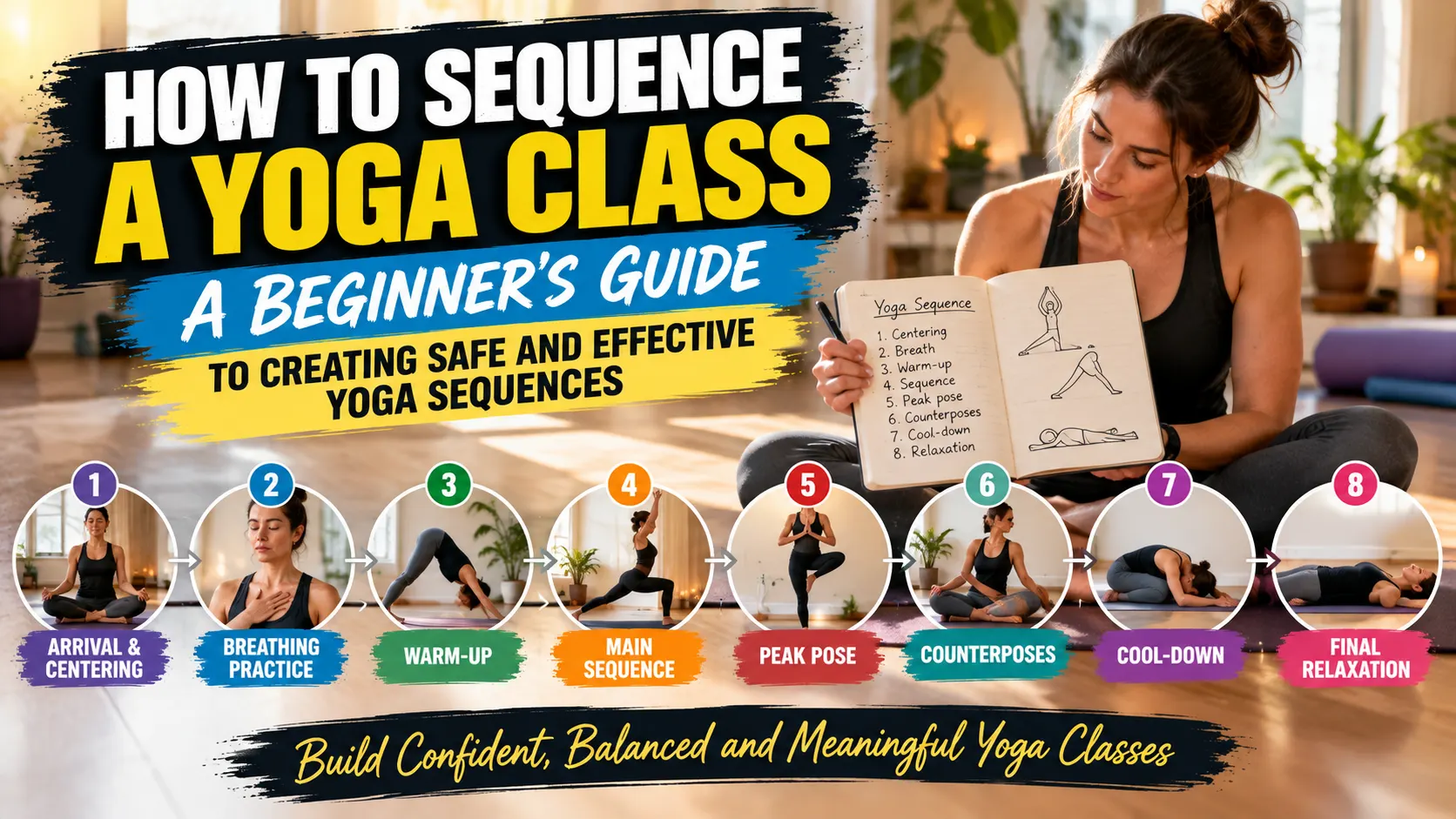
Understand the Basic Structure of a Yoga Class
Many effective yoga classes follow a broad progression from preparation to activity and then recovery.
A simple structure can include:
- Arrival and centering
- Breathing or awareness practice
- Warm-up
- Mobility and preparation
- Main movement sequence
- Peak pose or main focus
- Counterposes
- Cool-down
- Final relaxation
This does not mean every class must follow exactly the same structure.
Different styles of yoga use different approaches. However, this framework gives beginner teachers a useful starting point.
1. Begin With Arrival and Centering
The beginning of class gives students an opportunity to transition from their daily activities into the practice.
You might begin with:
- Comfortable seated breathing
- A short meditation
- Gentle lying-down awareness
- Simple breath observation
- Easy movement
- A short intention-setting practice
The opening does not need to be long.
Even two or three minutes of intentional arrival can help students become more present.
2. Use Gentle Warm-Up Movements
The warm-up prepares students for the physical demands of the class.
Depending on the focus, you might include:
- Neck movements
- Shoulder rolls
- Wrist and ankle movements
- Cat-Cow
- Gentle spinal rotation
- Pelvic movements
- Easy seated stretches
- Low-intensity standing movements
The warm-up should relate to what comes later.
For example, if your class will include several standing poses, gradually introduce weight-bearing through the feet and legs.
If your class will include deeper twists, prepare the spine with gentle rotation first.
This is one of the most useful principles of yoga class sequencing:
Prepare the body for what you are going to ask it to do.
3. Build From Simple to More Complex
A beginner-friendly sequence generally moves from simpler movements toward more complex ones.
This allows students to understand the movement pattern before increasing its difficulty.
For example:
Simple standing posture → Warrior II → Extended Side Angle → Half Moon
The exact sequence will depend on your class goal, but the principle remains the same.
Do not make the hardest movement the first major movement of the class.
Give students time to develop awareness, coordination, strength, and confidence.
Choosing Preparatory Poses
Preparatory poses are movements that help students become ready for a later posture.
Suppose your peak pose is Half Moon Pose.
You might prepare with:
- Standing balance
- Warrior II
- Triangle Pose
- Hamstring-focused movements
- Hip stability work
- Core engagement
- Easier balance variations
You are essentially creating a pathway toward the more challenging posture.
This approach makes the class feel intentional.
Students can also understand why they are performing particular movements.
How to Create a Logical Progression
A logical sequence should feel natural from one movement to the next.
When designing a class, ask:
What movement can naturally follow this one?
For example:
Mountain Pose
→ Chair Pose
→ Standing Forward Fold
→ Half Lift
→ Plank
→ Low Cobra
→ Downward-Facing Dog
The sequence works because the transitions are familiar and physically connected.
You should also consider where students are placing their hands, feet, and weight.
Unnecessary changes in direction can make a class difficult to follow.
Think About Transitions, Not Just Poses
One common mistake among new teachers is focusing only on individual poses.
Students do not experience your class as a list of separate postures. They experience the movement between them.
That means transitions matter.
A transition should ideally be:
- Clear
- Controlled
- Understandable
- Appropriate for the students
- Consistent with the pace of the class
For example, instead of suddenly telling students to move from a standing posture to the floor, provide enough instruction for them to understand how to make the transition.
Good sequencing includes the journey between poses.
How to Build Toward a Peak Pose
A peak pose is the main physical focus of a sequence.
It might be:
- Crow Pose
- Wheel Pose
- Headstand preparation
- Half Moon
- Dancer Pose
- Deep hip-opening posture
- A challenging twist
- A demanding standing balance
You do not necessarily need a dramatic peak pose in every class.
However, if you choose one, the rest of the sequence should support it.
For example, a class focused on Dancer Pose may include:
- Foot and ankle awareness
- Standing balance
- Quadriceps mobility
- Hip extension
- Shoulder mobility
- Core stability
- Balance preparation
The peak pose should feel like a logical development rather than something that suddenly appears halfway through class.
Avoid Making the Peak Pose Too Difficult
A peak pose should challenge students without making the entire class revolve around forcing them into a particular shape.
Remember that students have different:
- Mobility levels
- Strength levels
- Coordination
- Previous experience
- Body proportions
- Comfort levels
- Energy levels
A responsible teacher offers options.
For example:
Option 1: Stay with the basic balance.
Option 2: Use a wall or block.
Option 3: Explore the full variation if appropriate.
This allows students to participate without feeling pressured to perform the most advanced version.
Create a Balanced Yoga Sequence
A balanced sequence considers different types of movement.
Depending on the class, you may include:
- Forward folds
- Back-body strengthening
- Gentle backbends
- Twists
- Hip movements
- Side-body movements
- Standing poses
- Balance work
- Core movements
- Restorative positions
You do not need to include every movement category in every class.
Instead, consider the demands you place on the body and how you can balance them.
For example, after a physically demanding movement, you might introduce a gentler posture that allows students to recover.
How Long Should You Hold Each Pose?
There is no universal rule for how long every yoga pose should be held.
The appropriate duration depends on:
- Yoga style
- Class objective
- Student experience
- Pose difficulty
- Intensity
- Breathing pattern
- Teacher’s intention
A dynamic class may move through poses relatively quickly.
A slower class may hold postures for several breaths or longer.
Rather than asking only, “How long should I hold this pose?” ask:
What does this pose need to accomplish in this class?
If the purpose is movement and coordination, shorter periods may work.
If the purpose is awareness or gentle mobility, a longer stay may be appropriate.
How to Sequence a 30-Minute Yoga Class
A 30-minute class needs a clear structure because there is limited time.
A simple example could be:
Minutes 1–4: Centering
- Comfortable position
- Breath awareness
- Class intention
Minutes 4–8: Warm-Up
- Cat-Cow
- Gentle spinal movements
- Shoulder and hip mobility
Minutes 8–18: Main Sequence
- Tabletop movements
- Downward-Facing Dog
- Low lunge
- Warrior variations
- Simple balance
Minutes 18–24: Main Focus
- A selected balance, strength, or mobility sequence
- Appropriate modifications
Minutes 24–28: Cool-Down
- Gentle seated movement
- Forward fold
- Easy twist
Minutes 28–30: Relaxation
- Comfortable resting position
- Slow breathing
- Final stillness
The exact poses should change according to the purpose of the class.
How to Sequence a 60-Minute Yoga Class
A 60-minute class gives you more room to create progression.
One possible framework is:
0–5 Minutes: Arrival
Breathing, awareness, and intention.
5–12 Minutes: Warm-Up
Gentle spinal, shoulder, hip, and joint movements.
12–20 Minutes: Mobility and Preparation
Introduce movements connected to the main theme.
20–35 Minutes: Main Flow
Build strength, mobility, coordination, and movement awareness.
35–45 Minutes: Peak Sequence
Work toward the main posture or class objective.
45–52 Minutes: Counterposes and Recovery
Reduce intensity gradually.
52–57 Minutes: Gentle Cool-Down
Use comfortable floor-based movements.
57–60 Minutes: Savasana or Final Relaxation
Allow students to settle before ending the class.
This is only a framework. A restorative class, beginner class, power class, and meditation-focused class may all require different structures.
Consider the Experience Level of Your Students
The same sequence can feel completely different depending on who is attending.
A beginner class may require:
- More explanation
- Simpler transitions
- More demonstrations
- More rest
- Fewer complex poses
- More modifications
An experienced group may be comfortable with:
- More complex transitions
- Longer flows
- Greater variation
- Less verbal explanation
- More advanced options
This is why effective sequencing requires more than memorizing yoga poses.
You need to understand the people in front of you.
Build Modifications Into Your Sequence
A good yoga teacher does not create only one version of a pose.
Consider how students can modify the movement.
You might offer:
- Blocks
- Straps
- Blankets
- Wall support
- Kneeling alternatives
- Reduced range of motion
- Resting options
- Simpler variations
For example, instead of telling every student to perform a demanding balance, you can provide a supported version.
This creates a more inclusive class.
Use Props Intentionally
Props should have a purpose.
Blocks can help students bring the floor closer.
Straps can provide assistance when the hands cannot comfortably reach one another.
Blankets can support comfort and positioning.
Bolsters can provide support during restorative work.
The goal is not to use as many props as possible.
The goal is to use the appropriate tool when it improves the student’s experience.
Think About Energy and Intensity
Sequencing also involves managing energy.
A class can gradually increase intensity and then gradually reduce it.
For example:
Low intensity → moderate intensity → higher intensity → recovery → relaxation
This creates a natural arc.
If the class begins intensely and stays intense until the final minute, students may have difficulty transitioning into relaxation.
Likewise, if the entire class remains extremely gentle when students expected a stronger physical practice, the experience may not match the intention.
Common Yoga Sequencing Mistakes
New teachers often make similar mistakes when planning classes.
1. Choosing Too Many Poses
More poses do not automatically create a better class.
Trying to fit 40 poses into one hour can make the practice rushed.
2. No Clear Theme
If every pose is unrelated to the next, the class can feel random.
3. Introducing Difficult Poses Without Preparation
Students need appropriate preparation before challenging movements.
4. Ignoring Transitions
Moving between poses is part of the practice.
5. Making Everyone Do the Same Variation
Students have different needs and abilities.
6. Forgetting Recovery
A demanding sequence needs appropriate opportunities to reduce intensity.
7. Overcomplicating the Sequence
Complexity can make the class difficult to teach and difficult to follow.
8. Planning Only the Physical Portion
A complete yoga class may also include breathing, meditation, awareness, relaxation, and reflection.
Write Your Sequence Before Teaching
When you are learning how to create a yoga sequence, writing it down can be extremely helpful.
Create a simple planning sheet containing:
Class theme:
What is the purpose?
Student level:
Beginner, mixed, intermediate, or advanced?
Peak focus:
What is the main movement or experience?
Warm-up:
Which movements prepare students?
Main sequence:
How does the class progress?
Transitions:
How will students move between sections?
Modifications:
What alternatives will you offer?
Cool-down:
How will intensity decrease?
Final relaxation:
How will the class conclude?
This turns sequencing into a repeatable process rather than something you have to invent from scratch every time.
Practice Teaching Your Sequence
A sequence that looks good on paper may not work perfectly when taught.
Practice it yourself.
Notice:
- Where you become confused
- Where transitions feel awkward
- Whether you have enough time
- Whether instructions are clear
- Whether the intensity rises too quickly
- Whether students have enough recovery
- Whether the final relaxation feels rushed
You can also practice teaching the sequence aloud.
This connects sequencing with the communication skills you need as a teacher.
If you are developing these skills through formal training, a structured yoga teacher training program can provide opportunities to practice sequencing, teaching methodology, cueing, and class planning.
How Teacher Training Helps With Yoga Sequencing
Yoga teacher training can help you move beyond simply memorizing individual poses.
A comprehensive program may introduce you to:
- Class structure
- Sequencing principles
- Anatomy
- Teaching methodology
- Verbal cueing
- Demonstration
- Modifications
- Use of props
- Breath awareness
- Yoga philosophy
- Meditation
- Teaching practice
The purpose is to help you understand how these elements work together.
A 200-hour Yoga Teacher Training Summer Intensive can be particularly useful for students who want an immersive learning experience and want to develop the practical foundation required to begin teaching yoga.
A Simple Formula for Creating a Yoga Sequence
If you are completely new to sequencing, remember this basic framework:
Purpose → Prepare → Progress → Peak → Recover → Relax
Purpose
Decide what the class is about.
Prepare
Warm up the relevant areas of the body.
Progress
Gradually increase complexity or intensity.
Peak
Reach the main focus of the practice.
Recover
Reduce intensity with appropriate movements.
Relax
Finish with stillness, breathing, or relaxation.
This simple framework can help you design many different types of classes.
Example: Creating a Balance-Focused Sequence
Suppose your goal is to teach a class focused on balance.
You could structure it like this:
Opening
Breath awareness and grounding.
Warm-Up
Spinal movement, ankle mobility, and gentle standing movement.
Preparation
Mountain Pose, Chair Pose, Warrior II, and simple standing balance.
Progression
Tree Pose and other balance variations.
Peak
A more challenging balance such as Half Moon.
Recovery
Gentle standing and seated movements.
Cool-Down
Forward fold and comfortable twists.
Relaxation
Savasana.
Notice that the peak pose is not simply inserted into the middle of the class. The earlier movements prepare students for it.
How to Improve Your Sequencing Skills
Sequencing is a skill that improves with practice.
You can improve by:
- Studying experienced teachers
- Practicing different class structures
- Writing sequences regularly
- Teaching small groups
- Recording your teaching practice
- Reviewing transitions
- Learning basic anatomy
- Studying modifications
- Asking for student feedback
- Practicing the sequence yourself
Do not expect your first few sequences to be perfect.
The important thing is to understand why you are making each choice.
Over time, you will become faster at building sequences because you will understand how movements relate to one another.
Should Every Yoga Class Have a Peak Pose?
No.
A peak pose can be useful, but it is not mandatory.
A beginner relaxation class may have no obvious peak pose.
A meditation-focused class may prioritize breath and awareness.
A restorative class may focus on comfort and nervous-system downregulation rather than physical progression.
The concept of a peak should therefore be understood broadly.
The “peak” can simply be the main experience or purpose of the class.
How Do You Know If Your Sequence Works?
After teaching, ask yourself:
- Did students understand where they were going?
- Did the class feel rushed?
- Did the warm-up prepare students appropriately?
- Were transitions clear?
- Did the intensity progress naturally?
- Were modifications available?
- Did students have enough recovery?
- Did the final relaxation feel complete?
- Did the class achieve its original purpose?
These questions can help you improve each future sequence.
Frequently Asked Questions About Yoga Class Sequencing
How do I start sequencing a yoga class?
Start by deciding the purpose of the class. Then choose movements that prepare students for that purpose, gradually increase complexity or intensity, and finish with recovery and relaxation.
How many poses should be in a yoga class?
There is no fixed number. The appropriate number depends on the class length, style, student level, and pace. Quality and logical progression are more important than the number of poses.
What should come first in a yoga class?
Most classes begin with some form of arrival, breathing, awareness, or gentle movement. The opening should help students transition into the practice before physical intensity increases.
Should yoga classes have a peak pose?
Not necessarily. A peak pose can provide structure for some classes, but other classes may focus on relaxation, mobility, breathing, meditation, or another objective.
How long should a yoga sequence be?
The sequence should match the class duration. A 30-minute class needs a simpler structure, while a 60- or 90-minute class provides more room for preparation, progression, and recovery.
How do I sequence yoga poses for beginners?
Use simple movements first, provide clear transitions, avoid unnecessary complexity, and introduce challenging movements gradually. Give students modifications and enough time to understand each posture.
How can I make yoga transitions smoother?
Choose poses that naturally connect, reduce unnecessary changes in direction, and explain the movement before students need to perform it. Practicing the sequence yourself can reveal awkward transitions.
Do I need to know anatomy to create yoga sequences?
A basic understanding of anatomy is highly useful. It can help teachers understand movement, preparation, modifications, and how to avoid making inappropriate assumptions about students’ bodies.
Can I create my own yoga sequences after teacher training?
Yes. In fact, developing your own sequences is an important part of becoming a confident teacher. Training gives you principles and tools, while regular teaching practice helps you develop your own teaching style.
Is yoga sequencing taught in 200-hour teacher training?
Sequencing and teaching methodology are commonly important components of comprehensive 200-hour teacher training. If you are considering formal training, review the curriculum carefully to understand how much practical teaching and sequencing experience is included.
You can explore the 200-hour yoga teacher training to learn more about developing a foundation in yoga teaching.
Final Thoughts
Learning how to sequence a yoga class is one of the most important skills for a new yoga teacher.
A strong sequence is not simply a collection of impressive poses. It is a carefully considered journey that takes students from preparation to movement, from challenge to recovery, and ultimately toward greater awareness and relaxation.
Start with the purpose of the class. Prepare the body for the movements you plan to teach. Progress gradually. Keep transitions clear. Offer modifications. Allow enough recovery time. Then bring the class to a calm and intentional conclusion.
Most importantly, remember that sequencing is a skill that develops through practice.
If you are serious about becoming a yoga teacher, a structured 200-hour Yoga Teacher Training Summer Intensive can help you develop the knowledge, practical teaching experience, sequencing skills, and confidence needed to begin creating and teaching your own classes.