

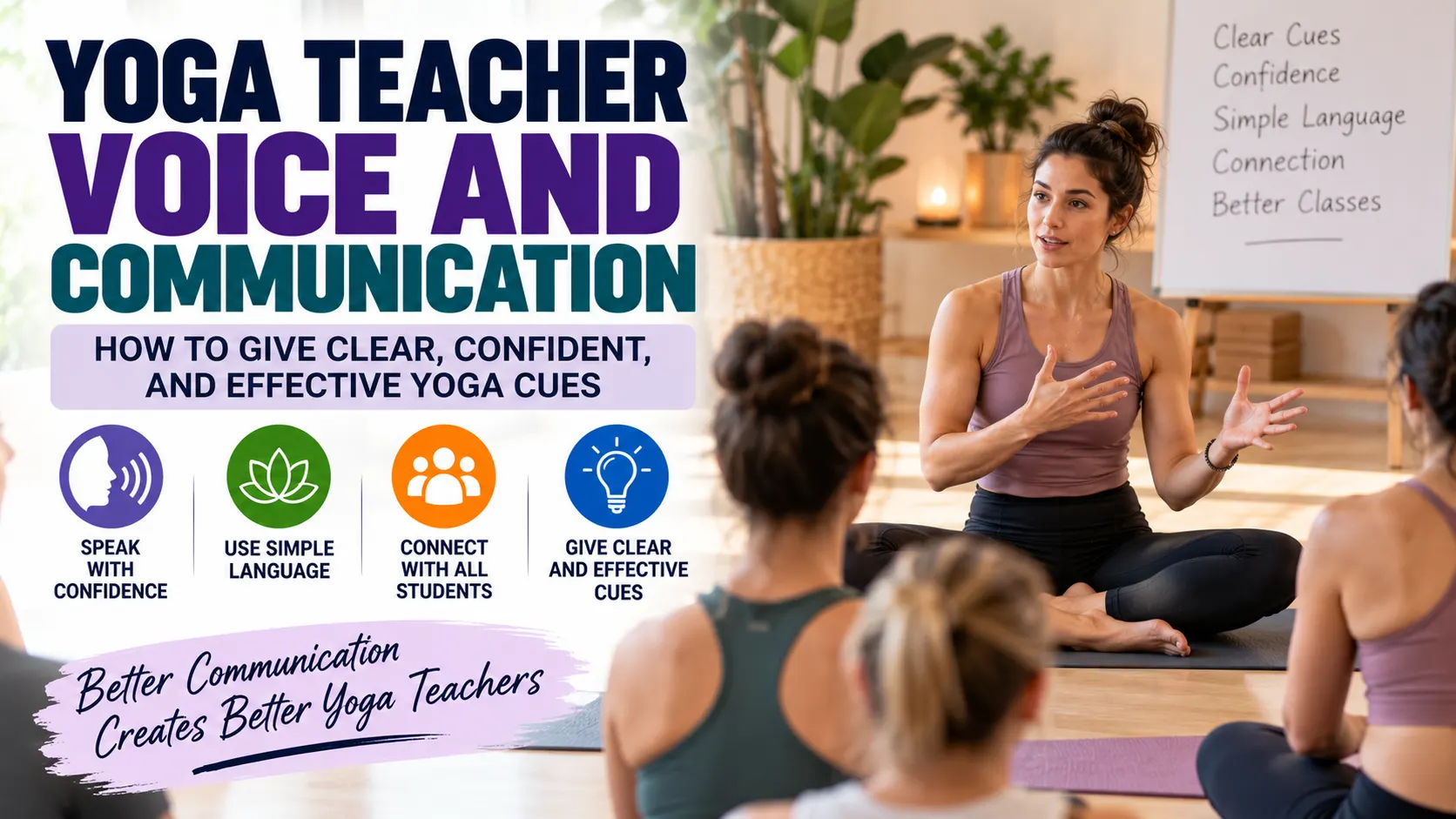
Being able to perform yoga poses is only one part of becoming a good yoga teacher. A teacher also needs to explain movements clearly, guide students through transitions, create a comfortable learning environment, and communicate with confidence.
This is why yoga teacher voice and communication are important skills for anyone preparing to teach yoga.
A teacher can know anatomy, yoga philosophy, breathing techniques, and alignment principles, but students still need to understand what they are being asked to do. If instructions are too complicated, too fast, too quiet, or unclear, students may struggle even when the teacher has strong knowledge.
Good yoga communication is not about speaking constantly. It is about using the right words at the right time.
In this guide, we will explore how yoga teachers can develop a clear teaching voice, give effective cues, communicate with different types of students, and become more confident when leading a yoga class.
Why Communication Matters in Yoga Teaching
A yoga class depends heavily on communication.
Students need instructions that help them understand:
- Where to place their body
- How to move
- When to breathe
- When to transition
- How to modify a pose
- What sensations to notice
- When to rest
Clear communication can make a class easier to follow and more comfortable for beginners.
It can also help experienced students understand more subtle aspects of a practice.
For aspiring teachers, communication is therefore an important part of yoga teaching methodology and should be practiced alongside physical yoga skills.
What Makes a Good Yoga Cue?
A yoga cue is an instruction that helps a student understand or perform a movement.
A useful cue is usually:
- Clear
- Short
- Specific
- Easy to understand
- Relevant to the movement
- Appropriate for the student’s experience
For example, instead of giving several instructions at once, a teacher might say:
“Step your right foot forward.”
Then, once students have moved:
“Place your back heel down.”
Then:
“Reach your arms overhead.”
Breaking instructions into manageable steps can make the class easier to follow.
Use Simple Language
One of the most common mistakes new teachers make is trying to sound overly technical.
Students do not need complicated language to understand yoga.
Instead of:
“Externally rotate the femur while maintaining optimal lumbopelvic stabilization.”
A beginner-friendly instruction might be:
“Turn your front thigh slightly outward while keeping your pelvis comfortable.”
The goal is not to make instructions sound sophisticated.
The goal is to make them understandable.
Speak With Confidence
Students often respond to the teacher’s confidence.
A teacher who speaks too quietly, constantly changes instructions, or sounds uncertain may make students feel unsure about what to do.
Confidence does not mean speaking aggressively.
A confident yoga teacher can:
- Speak clearly
- Use a steady pace
- Give instructions without unnecessary hesitation
- Pause when students need time
- Admit when something needs clarification
- Stay calm when a student asks a question
Confidence usually develops through practice rather than appearing overnight.
Your Voice Does Not Need to Sound Perfect
There is no single “yoga teacher voice.”
Some teachers have naturally soft voices. Others have stronger voices.
What matters is whether students can hear and understand you.
Focus on:
- Clear pronunciation
- Appropriate volume
- Comfortable breathing
- Steady pacing
- Natural expression
Trying to imitate another teacher’s voice can make your teaching feel unnatural.
Your goal should be to develop a voice that feels comfortable and authentic to you.
Use the Right Speaking Pace
Speaking too quickly is a common problem for new instructors.
When teachers are nervous, they may rush through instructions without realizing it.
Students then have to process the instruction, move their bodies, and listen for the next cue at the same time.
Slow down.
Give students enough time to respond.
For example:
“Bring your hands to the mat.”
Pause.
“Step your right foot forward.”
Pause.
“Lower your back knee.”
This creates space for students to move.
Do Not Over-Cue
More instructions do not necessarily mean better teaching.
If a teacher gives ten corrections during a simple pose, students may become overwhelmed.
Too many instructions can make students focus on following rules rather than experiencing the practice.
Choose the most important cue first.
If another instruction becomes necessary, add it later.
Give One Main Instruction at a Time
New teachers can benefit from using a simple teaching sequence:
Instruction → Pause → Observe → Add another cue
For example:
“Stand with your feet hip-width apart.”
Pause.
“Relax your shoulders.”
Pause.
“Take a slow breath in.”
This approach is easier for beginners to follow than delivering an entire paragraph of instructions at once.
Combine Verbal Instructions With Demonstration
Demonstration can be useful, particularly for beginners.
However, teachers should avoid relying entirely on demonstration.
A student may copy your movement without understanding what they are doing.
Use demonstration when appropriate, then explain the important points verbally.
This gives students both a visual and verbal reference.
Use Breath as Part of Your Cueing
Breathing can help create rhythm during a yoga class.
Simple instructions can connect movement with breath.
For example:
“Inhale and reach your arms overhead.”
“Exhale and fold forward.”
The exact breathing pattern depends on the practice and tradition being taught.
The important point is to make the breathing instruction clear and avoid adding unnecessary complexity.
Teach Beginners Differently From Experienced Students
Not every student needs the same amount of explanation.
Beginners
Beginners may benefit from:
- Simple language
- Basic pose instructions
- More demonstrations
- Extra time between transitions
- Clear explanations of unfamiliar terms
Experienced Students
Experienced practitioners may need less basic instruction and may benefit from:
- More detailed exploration
- Subtle alignment cues
- Breath awareness
- Variations
- Deeper movement concepts
A good teacher learns to adjust communication according to the class.
Use Sanskrit Carefully
Sanskrit terminology is an important part of many yoga traditions.
However, beginners may not recognize Sanskrit pose names immediately.
If you use a Sanskrit term, you can also provide the commonly understood English name.
For example:
“Come into Adho Mukha Svanasana, or Downward-Facing Dog.”
This allows students to gradually become familiar with traditional terminology without becoming confused.
How to Give Effective Alignment Cues
Alignment cues should help students understand movement without making them feel that every body must look exactly the same.
Instead of:
“Your knee must be exactly here.”
Try:
“Explore a position where your knee feels stable and comfortable.”
Instead of:
“Square your hips perfectly.”
Try:
“Orient your pelvis forward as much as feels comfortable.”
Good cueing allows students to understand the purpose of the movement while recognizing individual differences.
Avoid Absolute Language When It Is Not Necessary
Words such as “always,” “never,” “perfect,” and “wrong” can sometimes create unnecessary pressure.
Human bodies differ.
Students have different proportions, mobility, strength, experience, and physical histories.
A better approach is often to explain the intention behind the instruction.
For example:
“Find a stable position that allows you to breathe comfortably.”
This can be more useful than presenting one exact body shape as the only acceptable option.
Correct Students Respectfully
Correction is part of teaching, but the way you correct someone matters.
Avoid embarrassing students in front of the class.
Instead of:
“You’re doing that completely wrong.”
Try:
“Try bringing your foot slightly wider and see how that feels.”
The second approach gives the student useful information without making them feel judged.
Ask Students How They Feel
Communication should not only go from teacher to student.
Teachers can also encourage students to notice their own experience.
Useful questions include:
- “How does that feel?”
- “Can you breathe comfortably?”
- “Would you prefer the modified version?”
- “Does this position feel stable?”
- “Would you like to use a block?”
This encourages students to develop body awareness rather than simply obeying instructions.
Learn When to Stay Quiet
One of the most underrated yoga teaching skills is knowing when not to speak.
A yoga class does not need continuous talking.
After giving an instruction, allow students time to experience the pose.
Silence can provide space for:
- Breathing
- Concentration
- Body awareness
- Relaxation
- Meditation
A teacher who speaks constantly may unintentionally distract students from their practice.
Use Your Voice During Relaxation
The tone and volume of your voice can change depending on the part of the class.
During active movement, students may need clear and energetic instructions.
During relaxation or meditation, a slower and softer delivery may be more appropriate.
The voice should support the purpose of the practice rather than remain the same throughout the entire class.
How to Build Confidence as a Yoga Teacher
Confidence comes from repeated practice.
You can practice teaching by:
- Teaching a short sequence to a friend
- Recording yourself
- Practicing instructions aloud
- Teaching classmates
- Asking for feedback
- Reviewing your classes afterward
- Practicing different ways of explaining the same pose
You may feel uncomfortable at first.
That is normal.
The goal is not to eliminate nervousness immediately. The goal is to become comfortable enough to continue teaching clearly despite it.
Practice Your Cues Before Teaching
Before a class, review the main movements.
Think about:
- What students need to know first
- Which transitions may be difficult
- Where beginners may need modifications
- Which cues are essential
- Where you can allow silence
This can reduce unnecessary talking during the class.
Keep Your Instructions Consistent
Changing terminology repeatedly can confuse students.
For example, if you call a movement “standing forward fold” at the beginning of class and later call it something completely different without explanation, beginners may not realize you are describing the same movement.
Choose simple language and use it consistently.
Develop Your Own Teaching Style
Every good teacher eventually develops a personal teaching style.
Your style may be:
- Calm
- Energetic
- Detailed
- Simple
- Traditional
- Conversational
- Meditative
There is no need to copy another instructor exactly.
Study different teachers, learn from them, and gradually develop a communication style that feels natural to you.
Communication Skills in Yoga Teacher Training
Communication should be practiced during teacher training rather than treated as something that students will automatically learn after graduation.
A comprehensive yoga teacher training program can give aspiring teachers opportunities to study teaching methodology and practice communicating yoga instructions.
Students can learn how to:
- Structure a class
- Give verbal cues
- Demonstrate poses
- Explain modifications
- Observe students
- Manage transitions
- Practice teaching
The more opportunities students have to teach and receive feedback, the more natural communication can become.
Preparing for Your First Teaching Practice
Your first teaching practice does not need to be perfect.
Prepare a short sequence that you understand well.
Write down:
- Starting position
- Main poses
- Transitions
- Breathing instructions
- Modifications
- Closing sequence
Practice saying the instructions aloud.
You may notice that something that looks clear on paper sounds confusing when spoken.
That is exactly why practice matters.
How 200-Hour Training Can Help
A structured 200-hour yoga teacher training can help students develop foundational teaching skills alongside their own yoga practice.
Depending on the curriculum, students may have opportunities to study anatomy, yoga philosophy, teaching methodology, pranayama, meditation, sequencing, and practical teaching.
These areas work together.
Knowing a pose is one thing.
Knowing how to explain it to another person is another skill.
Common Yoga Teaching Communication Mistakes
Speaking Too Quickly
Give students time to process instructions.
Talking Constantly
Allow periods of silence when appropriate.
Using Too Much Technical Language
Use terminology that your students can understand.
Giving Too Many Corrections
Focus on the most important information first.
Speaking Too Quietly
Make sure everyone can hear you.
Copying Another Teacher
Develop your own natural communication style.
Giving Instructions Without Demonstration When Needed
Some movements are easier to understand when students can see them.
Forgetting to Observe the Class
Teaching should not be based entirely on a prepared script. Watch your students and adapt when necessary.
A Simple Cueing Framework for New Teachers
A useful framework is:
Step 1: Tell
Give the instruction.
Step 2: Show
Demonstrate when necessary.
Step 3: Pause
Give students time to respond.
Step 4: Observe
Look around the room.
Step 5: Refine
Give another cue only if it is useful.
This simple process can help new teachers avoid overwhelming their students.
Frequently Asked Questions
How can I become more confident when teaching yoga?
Practice teaching regularly. Record yourself, teach short sequences, ask for feedback, and become familiar with the class structure.
What makes a good yoga cue?
A good cue is clear, concise, relevant, and easy for the student to understand. It should help the student perform or understand the movement without unnecessary complexity.
Should yoga teachers talk throughout the entire class?
No. Continuous talking can become distracting. Give useful instructions and allow students time for movement, breathing, and awareness.
Should yoga teachers use Sanskrit?
Sanskrit can be useful and is an important part of many yoga traditions. For beginners, consider explaining the English name alongside the Sanskrit term.
How can I improve my yoga teaching voice?
Practice speaking aloud, record your teaching, work on your volume and pace, and find a natural tone rather than trying to imitate another teacher.
Is communication taught during yoga teacher training?
Many comprehensive teacher training programs include teaching methodology and practical teaching. Check the curriculum of the specific course you are considering.
Final Thoughts
A good yoga teacher does more than demonstrate poses.
A good teacher knows how to communicate.
Clear instructions, appropriate pacing, thoughtful cueing, respectful corrections, and comfortable use of silence can make a significant difference to the student experience.
You do not need a perfect voice or a complicated vocabulary. You need to communicate in a way that helps students understand, explore, and feel comfortable in their practice.
Communication skills develop through repetition. Practice your cues, teach short sequences, observe your students, listen to feedback, and gradually develop your own teaching style.
For people preparing for a career in yoga teaching, a structured <a href=”https://yogaeducation.org/200-hour-yoga-teacher-training-summer-intensive/“>200-hour Yoga Teacher Training Summer Intensive</a> can be an opportunity to develop foundational knowledge and practical teaching skills in a focused learning environment.