

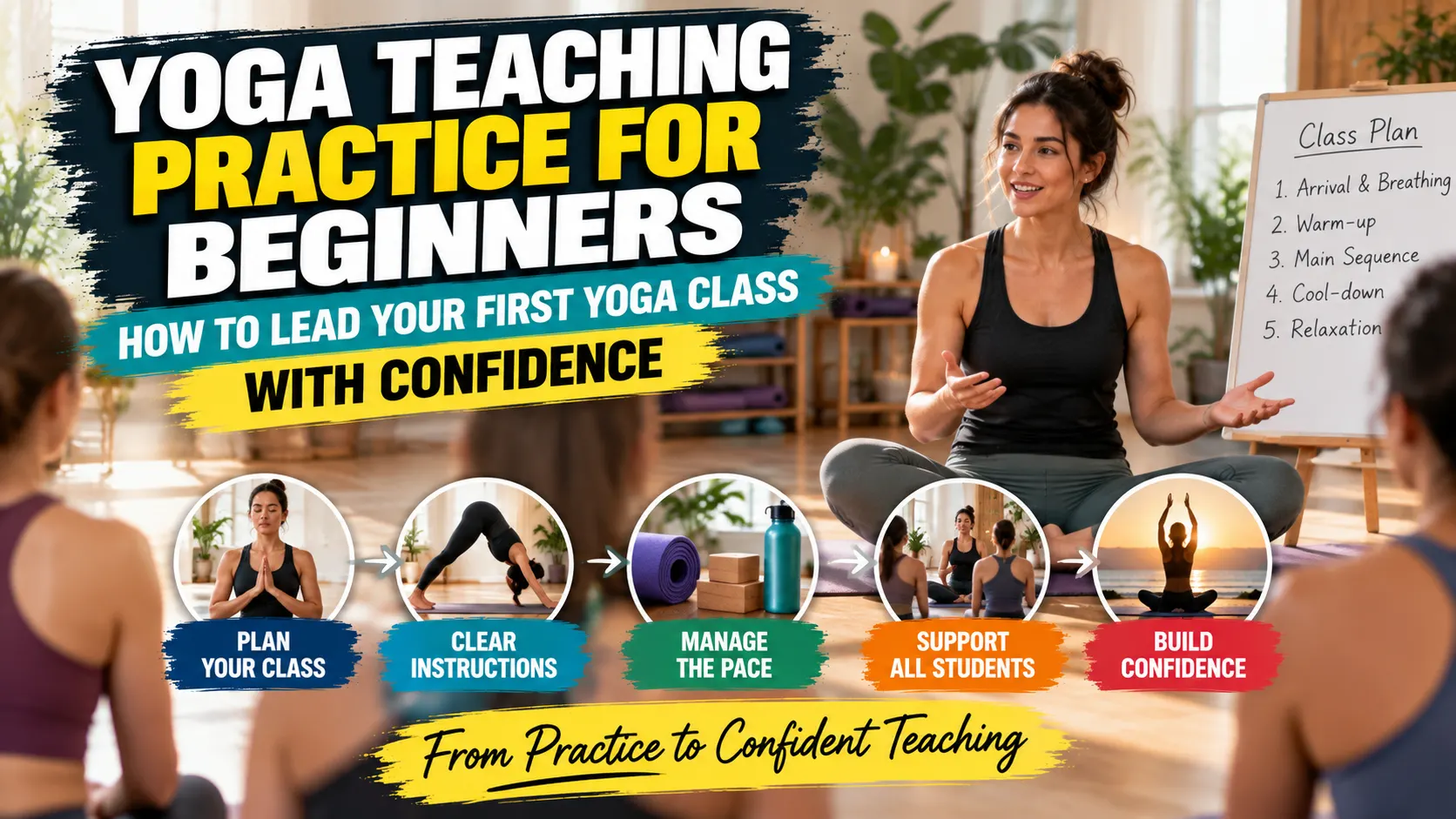
Teaching your first yoga class can feel exciting, challenging, and even a little intimidating. You may know the yoga poses, understand basic breathing techniques, and enjoy practicing regularly, but guiding other people through an entire session is a different experience.
As a new yoga teacher, you must think about much more than your own movements. You need to explain poses clearly, manage the pace of the class, observe your students, offer suitable modifications, and create an environment where people feel comfortable learning.
The good news is that confidence does not have to come before practice. In many cases, confidence develops through preparation, repetition, feedback, and real teaching experience.
Learning how to teach yoga is a gradual process. You do not need to sound like an experienced instructor from your first class. Instead, focus on helping students understand the practice, move at an appropriate pace, and feel supported throughout the session.
Whether you are preparing to teach friends, lead a small beginner group, or begin a professional teaching journey, this guide explains how to approach yoga teaching practice with a clear plan.
If you are considering formal training, a structured 200-hour yoga teacher training program can help you develop the foundational knowledge and practical skills needed to begin teaching yoga responsibly.
What Is Yoga Teaching Practice?
Yoga teaching practice is the process of learning to guide other people through yoga sessions. It involves applying your knowledge of postures, breathing, movement, relaxation, and teaching methods in a practical setting.
Reading about yoga or watching experienced teachers can help you understand the subject, but teaching requires additional skills.
You need to learn how to:
- Plan a complete yoga class.
- Explain postures using simple language.
- Demonstrate movements when appropriate.
- Guide students through transitions.
- Offer modifications for different abilities.
- Manage time and class structure.
- Observe students without making assumptions.
- Respond calmly when something does not go according to plan.
- Provide a clear beginning, middle, and end to each session.
These skills improve through consistent practice.
For beginners, the most useful approach is to start with simple classes, teach manageable groups, and gradually take on more responsibility as experience grows.
Why Is Teaching Your First Yoga Class Difficult?
Your first teaching experience may feel different from your personal yoga practice because your attention is divided.
When practicing alone, you can focus on your breathing, alignment, and physical sensations. When teaching, you must also think about your students and the overall structure of the class.
Several challenges commonly affect new teachers.
1. Nervousness and Self-Doubt
You may worry about forgetting a pose, giving the wrong instruction, or making a mistake in front of students.
These concerns are normal when learning a new skill.
Instead of trying to eliminate nervousness completely, prepare a simple sequence and practice teaching it aloud. Knowing what comes next can reduce the pressure of making decisions while teaching.
2. Finding the Right Words
A pose that feels familiar to you may be difficult to explain to someone else.
For example, you may understand how to enter Downward-Facing Dog without thinking about each step. A beginner, however, may need clear instructions about hand placement, foot position, and how to adjust the posture for comfort.
Practice explaining movements as if the student has never seen the pose before.
3. Managing the Class Pace
New teachers sometimes speak too quickly, move through poses too fast, or spend so long explaining one movement that the rest of the class becomes rushed.
Timing improves when you rehearse the full sequence with a clock and allow students enough time to understand each instruction.
4. Responding to Different Student Needs
Students may have different levels of experience, mobility, strength, balance, and confidence.
You cannot assume that everyone will perform the same pose in the same way.
A good beginner teacher prepares options and makes it clear that students can rest or choose a simpler variation when needed.
Step 1: Start With a Simple Yoga Class Plan
Before your first teaching session, decide what kind of class you want to lead.
Avoid trying to include every pose you know. A focused class is usually easier to teach and easier for beginners to follow.
Start by answering five questions:
- Who is the class for?
- How long will it last?
- What is the main purpose?
- Which poses will you teach?
- How will you finish the session?
For example, you might plan a 30-minute beginner class focused on gentle mobility, breathing awareness, and relaxation.
Your plan could include:
| Class section | Duration | Purpose |
| Arrival and breathing | 3 minutes | Help students settle |
| Gentle warm-up | 5 minutes | Prepare for movement |
| Main yoga sequence | 12 minutes | Practice basic postures |
| Gentle cool-down | 5 minutes | Reduce intensity |
| Final relaxation | 5 minutes | Finish calmly |
This is a sample structure, not a fixed rule. Adjust the timing and poses to suit your students, teaching style, and class objective.
A well-organized plan gives you a framework to follow without requiring you to memorize every word.
Step 2: Choose Poses You Can Explain Clearly
When preparing your first class, choose familiar, manageable postures that you understand well.
Depending on the students and the class purpose, suitable options may include:
- Mountain Pose
- Cat-Cow
- Child’s Pose
- Easy Seated Pose
- Gentle seated twists
- Low Lunge variations
- Bridge Pose
- Supported relaxation
These are examples rather than a universal beginner sequence. Some poses may need modifications or may not suit every student.
Before including a posture, ask yourself:
- Do I understand how to enter and leave this pose?
- Can I explain the main movement in simple language?
- Do I know common ways to make it more comfortable?
- Can I identify when a student should stop or choose another option?
If you cannot confidently answer these questions, practice the pose and study it further before teaching it.
You do not need an advanced pose to make a class valuable. Clear instruction and thoughtful pacing are more important than complexity.
Step 3: Practice Giving Clear Verbal Instructions
Your voice is one of your most important teaching tools.
Students need instructions they can understand while moving, breathing, and paying attention to their bodies.
Use short, direct sentences rather than long explanations.
For example:
Instead of saying, “Now try to organize your whole body into the correct position while engaging everything and finding the right alignment,” give students one or two clear actions.
You could say:
“Place your feet comfortably apart. Lengthen your spine. Relax your shoulders.”
This approach gives students time to process the information.
Use Action-Based Language
Useful instructions often begin with a simple action:
- Place your hands on the mat.
- Bend your knees as much as feels comfortable.
- Lengthen through your spine.
- Keep your breathing steady.
- Press gently through your feet.
- Relax your jaw and shoulders.
- Return to a comfortable position.
Be specific about what students should do, but avoid suggesting that every body must look exactly the same.
Give One Instruction at a Time
If you give six instructions in one breath, students may miss the most important one.
Try this sequence:
- Explain the movement.
- Allow students to begin.
- Observe how they respond.
- Offer one useful additional cue.
- Give students time to settle.
This creates a more manageable learning experience.
Step 4: Demonstrate Poses Without Losing Awareness of the Class
Demonstrations can be helpful, especially for beginners. However, demonstrating every movement is not always necessary.
If you demonstrate a pose, students can see the general shape and direction of the movement. But if you remain in the pose while trying to explain every detail, you may not be able to observe the group effectively.
Consider three approaches.
Demonstrate first: Show the movement briefly, return to a position where you can observe students, and then guide them through it.
Use verbal instruction: Explain a familiar movement while remaining available to observe the class.
Combine both: Demonstrate the main action, then provide short verbal cues as students practice.
Choose the method that best supports the students and the complexity of the pose.
You should also avoid presenting your own body as the only correct example. Students have different proportions and movement capabilities.
Step 5: Learn to Observe Students
Teaching yoga involves paying attention to more than whether students appear to match a pose.
Observe whether they seem confused, are struggling to follow the transition, appear uncomfortable, or need more time.
For example, if several students have difficulty moving from a standing pose to the floor, the problem may be the pace or the transition rather than the students themselves.
You can respond by slowing down and explaining the movement again.
What Should You Look For?
During practice, pay attention to:
- Whether students understand the instructions.
- Whether transitions are manageable.
- Whether anyone appears uncomfortable.
- Whether the pace allows time for breathing.
- Whether students know how to rest.
- Whether modifications are needed.
Do not assume that you can diagnose an injury or medical condition simply by observing a student’s movement.
If someone reports pain, encourage them to stop the movement and choose a comfortable alternative. Refer health-related questions to an appropriately qualified healthcare professional when needed.
Step 6: Offer Modifications and Alternatives
One of the most valuable habits for new yoga teachers is learning to provide options.
Not every student will find the same movement comfortable. A posture that feels straightforward to one person may feel challenging to another.
Depending on the pose, you may offer:
- A smaller range of movement.
- A supported variation.
- A chair or wall for balance.
- A yoga block or strap.
- A resting position.
- An alternative posture.
For example, a student who finds a standing balance difficult may use a wall for support or practice a simpler balance variation.
Explain that modifications are normal parts of yoga practice, not signs of failure.
Avoid pressuring students to attempt a more difficult variation.
Be Careful With Hands-On Adjustments
Physical adjustments require consent, appropriate training, and careful judgment. A student attending a class should not be assumed to agree to being touched.
For your first classes, prioritize clear verbal guidance and demonstrations. If you later use hands-on adjustments, learn appropriate consent procedures and relevant safety practices through qualified training.
Step 7: Learn How to Manage Your Teaching Voice
A confident teaching voice does not need to be loud, dramatic, or unusually soft.
It should be clear enough for students to hear and calm enough to support the style of class.
Focus on three things.
Pace: Speak slowly enough for students to understand, especially when introducing a new movement.
Volume: Make sure everyone can hear you without shouting.
Pauses: Leave space after instructions so students can respond.
Silence is useful, too. You do not need to speak constantly throughout the class.
Allow students to notice their breathing and experience a posture without receiving a new instruction every few seconds.
Step 8: Prepare for Mistakes Before They Happen
You may forget the next pose, lose track of time, or give an instruction that does not make sense to the group.
These situations do not have to ruin your class.
The best response is usually to pause, simplify, and return to your plan.
If You Forget the Next Pose
Keep a small sequence outline nearby. Take a moment to check it rather than rushing into a movement you have not prepared.
If Students Look Confused
Stop adding instructions. Demonstrate the movement or explain it in simpler language.
If You Run Out of Time
Do not rush the final relaxation to fit in every pose. Remove an optional movement and preserve enough time to finish calmly.
If a Pose Is Not Working
Offer a simpler alternative or move on to the next appropriate section.
If You Do Not Know the Answer to a Question
Be honest. Explain that you do not want to guess and that you will seek reliable information before responding.
Professional teaching is not about pretending to know everything. It is about making responsible decisions.
Step 9: Practice Teaching Before Leading a Full Class
You do not need to wait until you feel completely confident before practicing, but you should build your experience gradually.
A useful progression is:
Stage 1: Teach yourself aloud.
Perform a simple sequence and explain each movement as if students were present.
Stage 2: Practice with one willing person.
Ask a friend or fellow student to follow your instructions. Notice where they become confused.
Stage 3: Lead a short practice session.
Teach a 10- to 15-minute section rather than attempting a complex full-length class immediately.
Stage 4: Request specific feedback.
Ask what was clear, what felt rushed, and where additional explanation would help.
Stage 5: Expand gradually.
Once you can guide a short sequence comfortably, begin planning longer sessions.
Whenever possible, practice within a structured learning environment with appropriate supervision and feedback.
Step 10: Use Feedback to Improve Your Teaching
Feedback is more useful when you ask specific questions.
Instead of asking, “Was I good?” try asking:
- Were my instructions easy to understand?
- Did I move through the poses too quickly?
- Were there any confusing transitions?
- Did I give enough time to practice?
- Did the class feel connected from beginning to end?
- Were the modifications easy to follow?
- Did I allow enough time for relaxation?
Write down the answers after each session.
Choose one or two improvements for your next class. Trying to fix everything at once can make teaching feel unnecessarily difficult.
You can also record yourself practicing, provided you respect the privacy and consent of anyone involved.
Listen to your pacing and clarity. You may discover that you speak too quickly, repeat the same instruction, or leave too little time between movements.
Step 11: Learn to Sequence a Class Around One Main Purpose
A class becomes easier to teach when its movements have a clear connection.
For example, a gentle mobility class might focus on spinal movement and comfortable range of motion.
You could structure it as follows:
Opening: Breath awareness in a comfortable position.
Warm-up: Gentle Cat-Cow and easy spinal movements.
Preparation: Comfortable shoulder and hip mobility.
Main practice: A small selection of gentle postures connected to the class theme.
Cool-down: Slower movements and comfortable seated positions.
Closing: Final relaxation.
The exact sequence should depend on the participants and your training.
This simple structure helps you avoid selecting poses randomly.
For more guidance on planning the order of postures, read this guide to how to sequence a yoga class.
Step 12: Understand Your Responsibility as a Yoga Teacher
Teaching yoga requires awareness of your professional boundaries.
You can guide movement, breathing, relaxation, and yoga-related learning within the scope of your training. However, you should not present yourself as a healthcare professional unless you hold the appropriate qualifications.
Avoid promising that yoga will cure medical conditions or guarantee particular physical or psychological outcomes.
Before a class, explain that students should work within their comfort levels and can rest whenever needed.
Encourage participants to consult an appropriately qualified healthcare professional if they have health concerns that may affect their participation.
Respect privacy, obtain consent for any physical contact, and avoid pressuring students to discuss personal matters.
A safe teaching environment depends on clear communication, appropriate preparation, and respect for individual choice.
How Yoga Teacher Training Supports Teaching Practice
Self-practice is valuable, but becoming a yoga teacher involves learning skills that are not always developed through personal practice alone.
A comprehensive teacher-training program may cover:
- Yoga postures and their variations.
- Anatomy and movement principles.
- Breathing techniques.
- Meditation and relaxation.
- Yoga philosophy.
- Class sequencing.
- Verbal cueing.
- Teaching methodology.
- Student observation.
- Practical teaching sessions.
- Feedback and reflective learning.
These subjects can help new teachers understand how to plan and deliver classes rather than simply demonstrate postures.
A 200-hour Yoga Teacher Training Summer Intensive may be an option for people seeking a more immersive introduction to yoga teaching. Before enrolling, review the program’s curriculum, practical teaching requirements, instructor qualifications, and any relevant certification or registration arrangements.
The most useful training experience is one that gives you opportunities to practice teaching, receive constructive feedback, and understand how to work responsibly with different students.
Frequently Asked Questions
How do I start teaching yoga as a beginner?
Begin by learning the foundations of yoga, practicing clear verbal instructions, and preparing simple class plans. Rehearse aloud, practice with willing participants, and seek feedback from a qualified teacher or training environment.
Do I need to be an advanced yoga practitioner to teach?
You do not necessarily need to perform advanced poses to teach yoga. However, you need appropriate knowledge, practical teaching skills, and an understanding of your professional responsibilities. Formal training can help you build these foundations.
How can I overcome nervousness before my first yoga class?
Prepare a manageable sequence, practice it aloud, arrive early, and keep a simple outline nearby. Focus on helping students rather than trying to deliver a perfect performance. Confidence often develops with repeated practice.
What should I teach in my first yoga class?
Choose a class objective and use familiar, manageable movements that you can explain clearly. Include an appropriate warm-up, a small main sequence, modifications, and time to finish calmly.
How long should a beginner yoga teacher’s first class be?
A short session of around 10 to 20 minutes can be useful for practice before you lead a longer class. The appropriate length depends on your preparation, the participants, and the learning environment.
How do I give better yoga instructions?
Use simple action-based language, give one instruction at a time, and allow students to respond. Practice explaining poses aloud and observe whether your words help students understand the movement.
What should I do if a student cannot perform a pose?
Offer an appropriate modification, a supported version, or a comfortable alternative. Avoid pressuring students to copy a particular shape, and encourage them to stop if they experience pain or discomfort.
How do I know if my first yoga class went well?
Consider whether students understood your instructions, whether the sequence felt manageable, whether you allowed enough time for transitions and rest, and whether the class achieved its objective. Ask for specific feedback and use it to improve.
Is yoga teacher training necessary to become a confident teacher?
Confidence comes from knowledge and practice, but formal training can provide structured learning in anatomy, sequencing, cueing, teaching methodology, and practical teaching. Check the requirements relevant to your intended teaching role and location.
What is the most important skill for a new yoga teacher?
There is no single skill that guarantees success. Clear communication, thoughtful preparation, student awareness, adaptability, and respect for individual needs are all important. Being willing to learn from feedback is equally valuable.
Final Thoughts
Your first yoga class does not have to be perfect. It needs to be prepared thoughtfully, taught clearly, and adapted to the needs of the students in front of you.
Start with a simple plan. Choose poses you understand, practice your instructions, leave enough time for transitions, and offer alternatives when needed. If you make a mistake, pause and make a sensible adjustment rather than rushing to hide it.
Most importantly, treat every teaching session as an opportunity to learn.
With consistent practice, constructive feedback, and appropriate training, you can develop the confidence to lead classes that are organized, welcoming, and responsive to your students.
If you want to develop your skills systematically, explore the 200-hour Yoga Teacher Training Summer Intensive and review how its curriculum and practical teaching components align with your goals.